
Is Your Employee Handbook Legally Compliant? A UK SME Checklist
May 06, 2026
If your employee handbook hasn't been touched since 2023, it's almost certainly out of date, and depending on what's in it, that's a legal risk you don't want sitting in a drawer.
The Employment Rights Act 2025 has rewritten parts of the rulebook. Day-one rights are arriving in stages from April 2026, and the policies you may have copied from a free employee handbook UK template a few years ago no longer reflect what UK law expects. For SMEs, the handbook is one of the cheapest, most powerful HR tools you have, but only if it's accurate.
This guide is a clear UK SME checklist: what's legally required, what's strongly recommended, what's changed in 2025, and how to use a workplace inspection checklist review to find the gaps. Use it alongside any employee handbook UK template, including your own.
Is an Employee Handbook a Legal Requirement in the UK?
The short answer is no. There is no UK law that says you must have an employee handbook.
What the law does require is a written statement of employment particulars under section 1 of the Employment Rights Act 1996. Since April 2020, you must give every worker their day-one statement on or before their first day, and it must cover specific terms like pay, hours, place of work, notice and holiday entitlement.
What sits inside the handbook itself isn't mandated by name, but the policies it contains often are. A grievance and disciplinary procedure must be in writing and accessible to staff. A health and safety policy is required if you employ five or more people. Several other policies, including equal opportunities, anti-harassment and data protection, are not legally compulsory by name. However, if a tribunal asks how you prevented harassment or handled a discrimination claim, "we don't have a written policy" is the worst possible answer.
In other words, your handbook isn't legally required, but the absence of one creates legal risk in nearly every direction.
What Policies Are Required by Law in the UK?
Three policies must exist in writing for any UK employer.
- Disciplinary procedure. Required by section 3 of the Employment Rights Act 1996 to be in writing and given to employees. It must reflect the ACAS Code of Practice on disciplinary and grievance procedures. Failure to follow the Code can increase any tribunal award by up to 25%.
- Grievance procedure. Also required in writing under section 3. It must explain how an employee raises a concern, who hears it and how an appeal works. The same ACAS Code applies.
- Health and safety policy. Required under section 2(3) of the Health and Safety at Work etc. Act 1974 for any employer with five or more employees. It must be in writing, set out your arrangements for managing risk and be communicated to all staff.
Beyond these three, several policies are functionally required because they evidence your compliance with broader legal duties:
- Equal opportunities and anti-harassment. The Equality Act 2010 makes you liable for discrimination and harassment by employees unless you have taken "all reasonable steps" to prevent it. The Worker Protection (Amendment of Equality Act 2010) Act 2023 strengthened this further from October 2024 with a positive duty to prevent sexual harassment.
- Data protection. UK GDPR and the Data Protection Act 2018 require you to inform staff how their personal data is processed.
- Family leave. Maternity, paternity, adoption, shared parental, parental and neonatal care leave each carry statutory entitlements that need a written explanation so staff know how to claim them.
- Working time and rest breaks, under the Working Time Regulations 1998.
- Whistleblowing. Protected disclosures under the Public Interest Disclosure Act 1998.
If you are starting from a free employee handbook UK template, check that all of the above are present and tailored to your business. Generic templates often miss the recent changes around sexual harassment, flexible working, day-one rights and neonatal care leave.
The Full List of UK Policies Your Handbook Should Include
Here is a working list of UK policies most SMEs need, grouped by priority. Use it as a quick gap-check against your current handbook.
Legally required (or required to evidence legal compliance):
- Disciplinary procedure
- Grievance procedure
- Health and safety policy (5+ employees)
- Equal opportunities and anti-discrimination
- Anti-harassment and anti-bullying (with sexual harassment prevention)
- Data protection and privacy
- Whistleblowing
- Family leave: maternity, paternity, adoption, shared parental, parental, neonatal care
- Working time, rest breaks and annual leave
- Sickness absence and statutory sick pay
- Right to work and immigration checks
Strongly recommended for SMEs:
- Flexible working
- Performance management and capability
- Redundancy procedure
- Probationary period
- IT, email and social media use
- Bring Your Own Device (BYOD)
- Mobile phone and driving at work
- Drug, alcohol and substance misuse
- Lone working
- Expenses and business travel
- Confidentiality and intellectual property
- Conflicts of interest
Situational, to include if relevant to your business:
- Hybrid and remote working
- Time off for dependants and carers' leave
- Menopause and reproductive health
- Mental health and wellbeing
- Religious observance and time off
- Volunteering and time off for public duties
- Probation extension
- Acceptable use of AI tools at work
This isn't a comprehensive list of every UK policy that could ever exist. It's the working set most SMEs need. Larger or higher-risk employers, particularly in financial services, healthcare or anything with safeguarding obligations, will need additional sector-specific policies.
Employee Handbook Updates for 2025: What Has Changed
If your handbook was written before 2024, these are the updates you almost certainly need to make.
Sexual harassment: positive duty to prevent (October 2024)
Employers must now take "reasonable steps" to prevent sexual harassment of workers. Your anti-harassment policy needs to spell out training, reporting routes, third-party harassment and the steps you have taken, not just a statement of zero tolerance.
Flexible working as a day-one right (April 2024)
Employees can request flexible working from day one. They can make two requests in any 12-month period, and you must respond within two months. Update the policy and remove any reference to a 26-week qualifying period.
Carer's leave (April 2024)
A new statutory right to one week's unpaid leave per year for employees with long-term caring responsibilities. Add a standalone policy or fold it into your family leave section.
Neonatal care leave and pay (April 2025)
Up to 12 weeks of paid leave for parents whose baby needs neonatal care. This is a day-one right and needs its own policy.
Tipping (October 2024)
The Employment (Allocation of Tips) Act 2023 came into force, requiring fair distribution of tips and a written tipping policy in any business where tips are received more than occasionally.
Statutory rates (April 2025 and April 2026)
National Minimum Wage, statutory maternity, paternity, adoption, shared parental and sick pay all change each April. If your handbook quotes specific rates, replace them with "the prevailing statutory rate" or commit to updating annually.
Employment Rights Act 2025: Coming into Force in Stages
SSP from day one and removal of the lower earnings limit takes effect on 6 April 2026. From 1 January 2027, the qualifying period for ordinary unfair dismissal drops from two years to six months. The original day-one proposal was dropped in November 2025 in favour of this six-month threshold. The statutory cap on compensatory awards for ordinary unfair dismissal will also be removed from 1 January 2027, and tribunal time limits will extend to six months.
Start preparing your sickness absence, probation and dismissal procedures now rather than scrambling later. If you have not addressed at least four of the items above, your handbook is functionally out of date.
Workplace Inspection Checklist UK: The Health and Safety Side
Compliance is not just paper. The HSE expects your written health and safety policy to be matched by what is happening on site. A simple workplace inspection checklist that UK employers can run quarterly covers four areas.
General workplace:
- Walkways and exits clear; fire doors not propped open
- Lighting is adequate, including emergency lighting, and tested
- Floors clean, dry and free from trip hazards
- Temperature is comfortable (Workplace (Health, Safety and Welfare) Regulations 1992 suggest a minimum of 16°C, or 13°C for physical work)
- Adequate ventilation and welfare facilities, including toilets, drinking water and a rest area
Equipment and electricals:
- PAT testing in date for portable appliances
- Display screen equipment (DSE) assessments completed for all regular users
- Manual handling assessments for any role involving lifting
- PPE provided, fit-for-purpose and free of charge
Documentation and people:
- Health and safety policy displayed or accessible
- Risk assessments current, with reviews at least annually or after any change
- Accident book in place; incidents reported to RIDDOR where required
- First aiders appointed and trained; first aid kit stocked
- Fire risk assessment current; fire drills carried out at least annually
- Employer's liability insurance certificate displayed (£5 million minimum cover)
Training:
- Induction covers H&S, fire and key policies
- Refresher training logged for first aiders, fire marshals and DSE
- Training records are kept for at least three years
Walk this checklist quarterly. If you cannot tick every box, your handbook's health and safety policy is making promises your workplace is not keeping.
Your Employee Handbook UK Template Compliance Checklist
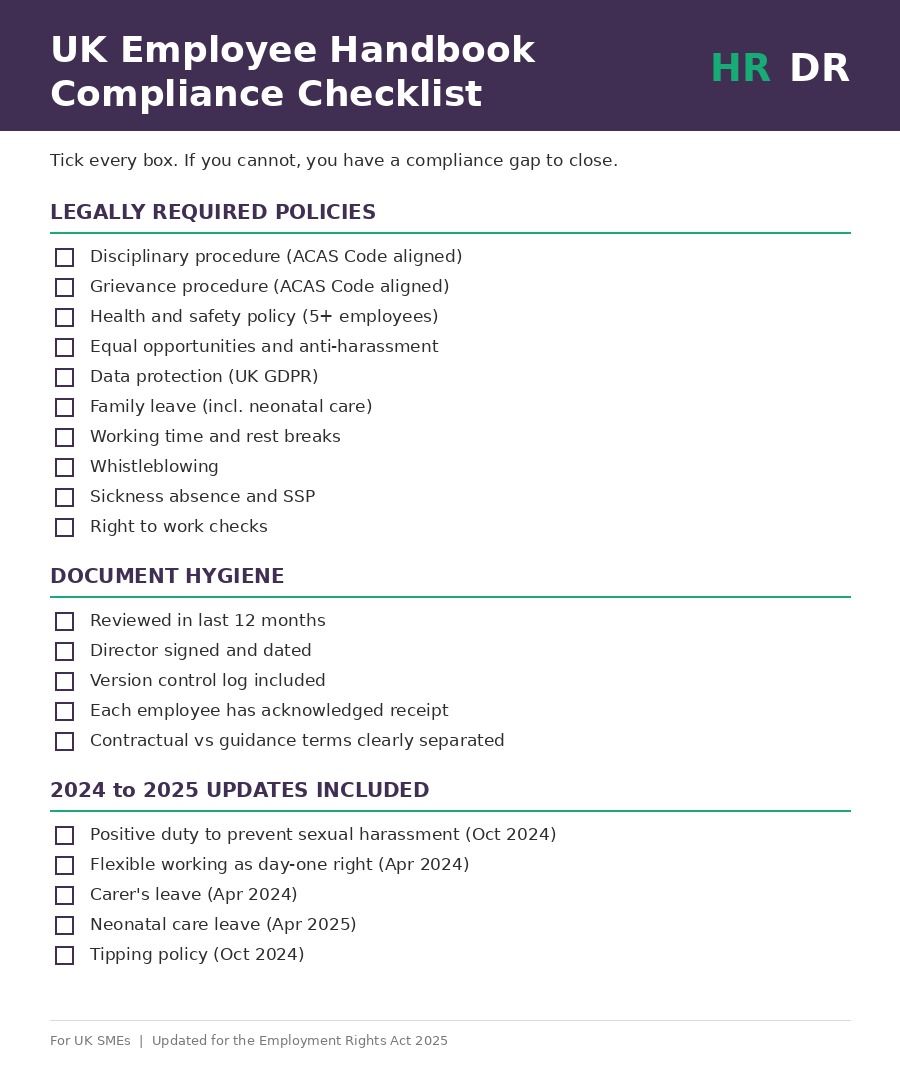
Use this as a final review pass. If you cannot tick every box, you have a compliance gap to close.
- All three legally required policies (disciplinary, grievance, health and safety) are present and follow the ACAS Code where relevant
- Every policy reflects the law as of the most recent April uplift
- The 2024–2025 changes are reflected: positive sexual harassment duty, day-one flexible working, carer's leave, neonatal care leave, tipping
- Statutory rates are either current or replaced with "the prevailing statutory rate"
- Equality Act 2010 protected characteristics are correctly listed (there are nine)
- Data protection policy reflects UK GDPR, not pre-2018 wording
- The handbook is signed off by a director or senior manager and dated
- Each employee has acknowledged receipt in writing or electronically
- A version control log exists at the front or back of the handbook
- The handbook is reviewed at least annually and after any major legal change
- Contractual and non-contractual terms are clearly distinguished, as this is where most disputes start
- Plain English throughout, with no clauses copied and pasted from US templates
Common Compliance Gaps in SME Handbooks
Three patterns come up repeatedly.
The handbook contradicts the contract. A free employee handbook UK template might say notice is one month, but the contract says one week. A tribunal will go with whichever is more favourable to the employee. Read your employment contracts and handbook side by side at every review.
Everything is "contractual" by accident. If your handbook does not explicitly say which parts are contractual and which are guidance, every clause risks becoming a contractual term, which means you cannot change it without consent. Add a clear statement up front.
The disciplinary procedure does not match what you do. If your written policy says "two written warnings before dismissal" and you skip to a final written warning, you have breached your own process. Either follow the policy or rewrite it so it reflects how you genuinely operate.
When and How Often to Update Your Handbook
Twice a year is the safe rhythm: a thorough review every April for statutory rates and new April legislation, and a lighter review in October for the autumn budget and regulations laid before year-end. On top of that, update immediately whenever:
- Legislation changes mid-year, as the Employment Rights Act 2025 rollout is a multi-year example
- Your headcount crosses a threshold (five employees for a written H&S policy, fifty for collective consultation timelines, 250 for gender pay gap reporting)
- You open a new site, country or working pattern such as hybrid, night work or lone working
- A near-miss, complaint or tribunal claim reveals a gap
- You roll out new technology such as AI tools, new platforms or BYOD
Date every version, log what changed, and re-issue the handbook to staff with a fresh acknowledgement each time.
FAQs
Is an employee handbook a legal requirement in the UK?
No, but a written statement of employment particulars is, and several individual policies must exist in writing: disciplinary, grievance, and health and safety for employers with five or more staff. A handbook is the most efficient way to meet those obligations in one place.
What policies must be included in a UK employee handbook?
At a minimum, disciplinary, grievance and health and safety. Add equal opportunities, anti-harassment, data protection, family leave, working time, whistleblowing, sickness absence and right to work to evidence compliance with the Equality Act 2010, UK GDPR and other statutory duties. Most SMEs need around twenty policies in total.
How often should I update my employee handbook?
At least once a year, with a fuller review every April when statutory rates and new employment legislation typically take effect. Update immediately whenever the law changes, your headcount crosses a regulatory threshold, or your working patterns shift.
Can I use a free employee handbook UK template?
You can use one as a starting point, but it should never be your finished handbook. Free templates are generic, often out of date, and rarely reflect the most recent legislation, such as the sexual harassment positive duty, flexible working day-one rights and neonatal care leave. Treat any template as a draft to be checked clause by clause against current UK law and your actual working practices.
What is the difference between an employee handbook and a written statement of particulars?
The written statement is a legal document that sets out the core terms of an individual's employment, including pay, hours, notice and holidays, and must be issued on or before day one under the Employment Rights Act 1996. The handbook is a wider document containing your policies, procedures and expectations. Most SMEs reference the handbook from the written statement and contract, distinguishing clearly which clauses are contractual and which are guidance.
Final Thoughts
A handbook is not a tick-box exercise. It is the document your tribunal, your insurer, and your auditor will all ask for first when something goes wrong, and it is the most cost-effective tool you have for stopping that something from happening in the first place.
If your current employee handbook UK template has not been reviewed against the 2024–2025 changes, set aside an afternoon, run it through the checklist above, and either fix it yourself or get help fixing it. The cost of an out-of-date handbook is always higher than the cost of updating one.
Not sure your handbook stacks up? We've put together a Compliance Confidence Kit built specifically for UK SMEs. It's designed to help you spot the gaps and bring your policies in line with the Employment Rights Act 2025 and the 2024–2025 statutory changes, all in one place.
If you'd rather have a human walk you through it, HRDR also offers a fixed-price employee handbook review and rewrite, with a free 30-minute call to scope out exactly what your business needs.
Get the Compliance Confidence Kit Today by booking a free 30-minute call.