Employment Rights Bill Update 2026: Roadmap, Key Changes and Day One Rights Explained
Mar 09, 2026
If you run a business or lead people in the UK, the Employment Rights Bill is the single biggest change to employment law you will face in your working lifetime. It is not a tweak. It is not a minor update to a few existing rules. It is a fundamental shift in the relationship between employers and employees, and if you are not already thinking about how it affects your business, you are behind.
This guide covers everything you need to know: what the Bill is, where it currently stands, the implementation roadmap, what day one employment rights mean in practice, and critically, what SMEs need to do right now to avoid being caught out when the changes bite.
What Is the Employment Rights Bill?
The Employment Rights Bill is landmark legislation introduced by the Labour government in October 2024. It is the most ambitious overhaul of UK employment law since the Employment Rights Act 1996, the foundational piece of legislation that has governed the employer-employee relationship for the past three decades.
The Bill was introduced on the back of Labour's election manifesto commitments around workers' rights and follows years of campaigning by trade unions and workers' groups who argued that the existing framework had failed to keep pace with modern working patterns, the rise of the gig economy, and the growth of insecure, low-paid employment.
In scope, it is vast. The Bill touches on unfair dismissal, probation periods, zero-hours contracts, flexible working, statutory sick pay, trade union rights, collective redundancy, equality, and much more. It runs to hundreds of pages and will require a significant volume of secondary legislation, regulations, codes of practice, and commencement orders to fully bring it into effect.
At its core, the Bill is built around one central idea: that workers should have stronger protections, more predictable conditions, and greater security from the very start of their employment. For employees, that sounds positive. For employers, particularly smaller businesses without dedicated HR support, it creates real complexity, real cost, and real risk.
Why Was It Introduced?
To understand what the Bill is trying to fix, it helps to understand what it is reacting to. The UK's existing employment law framework was largely designed for a world of permanent, full-time employment. The growth of zero-hours contracts, agency working, and self-employment, particularly through platforms and the wider gig economy, created a large population of workers who fell outside the traditional protections.
At the same time, the two-year qualifying period for unfair dismissal meant that millions of workers in their first two years of employment had effectively no protection against being dismissed without reason. Critics argued this created an imbalance of power that was used, consciously or not, to suppress wages, avoid performance management conversations, and dismiss workers who raised concerns or complaints.
The Bill is Labour's answer to those criticisms. Whether you agree with the policy direction or not, the legislative reality is clear: the rules are changing, and employers need to adapt.
Is the Employment Rights Bill Now Law?
As of March 2026, the Employment Rights Bill has received Royal Assent and is formally the Employment Rights Act 2025. It is the law. However, and this is an important distinction, most of its provisions are not yet in force. The Act is being implemented in phases through commencement orders and secondary legislation, which means different parts of the law take effect at different times.
This phased approach was partly a political compromise and partly a practical necessity. Changing something as fundamental as the unfair dismissal qualifying period requires time for ACAS to review its guidance, for employment tribunals to prepare for increased caseloads, and for employers to restructure their HR processes.
The bottom line: the law is passed, the implementation clock is ticking, and some of the most significant changes arrive from January 2027.
Employment Rights Bill Update 2026: Latest Position
The pace of implementation has accelerated in early 2026. Here is where things stand as of March 2026.
Royal Assent Confirmed
The Employment Rights Bill received Royal Assent in 2025 and is now an Act of Parliament. This was a significant milestone, but not, in itself, the trigger for any practical changes.
Secondary Legislation in Progress
The government is laying secondary regulations before Parliament in stages. These flesh out the detail of the Act's provisions, including, for example, the reference period for guaranteed hours under zero-hours reforms.
ACAS Guidance: Monitor for Updates
Guidance Note
ACAS guidance and any relevant Codes should be monitored as implementation details are consulted on and finalised. Employers will be expected to follow any updated guidance, and deviation from it can be taken into account by employment tribunals when assessing compensation.
Later 2026 and Into 2027: Further Provisions
Zero-hours contract reforms, enhanced trade union rights, and changes to collective redundancy thresholds are expected to follow. The government has signalled further consultation before finalising some of these details.
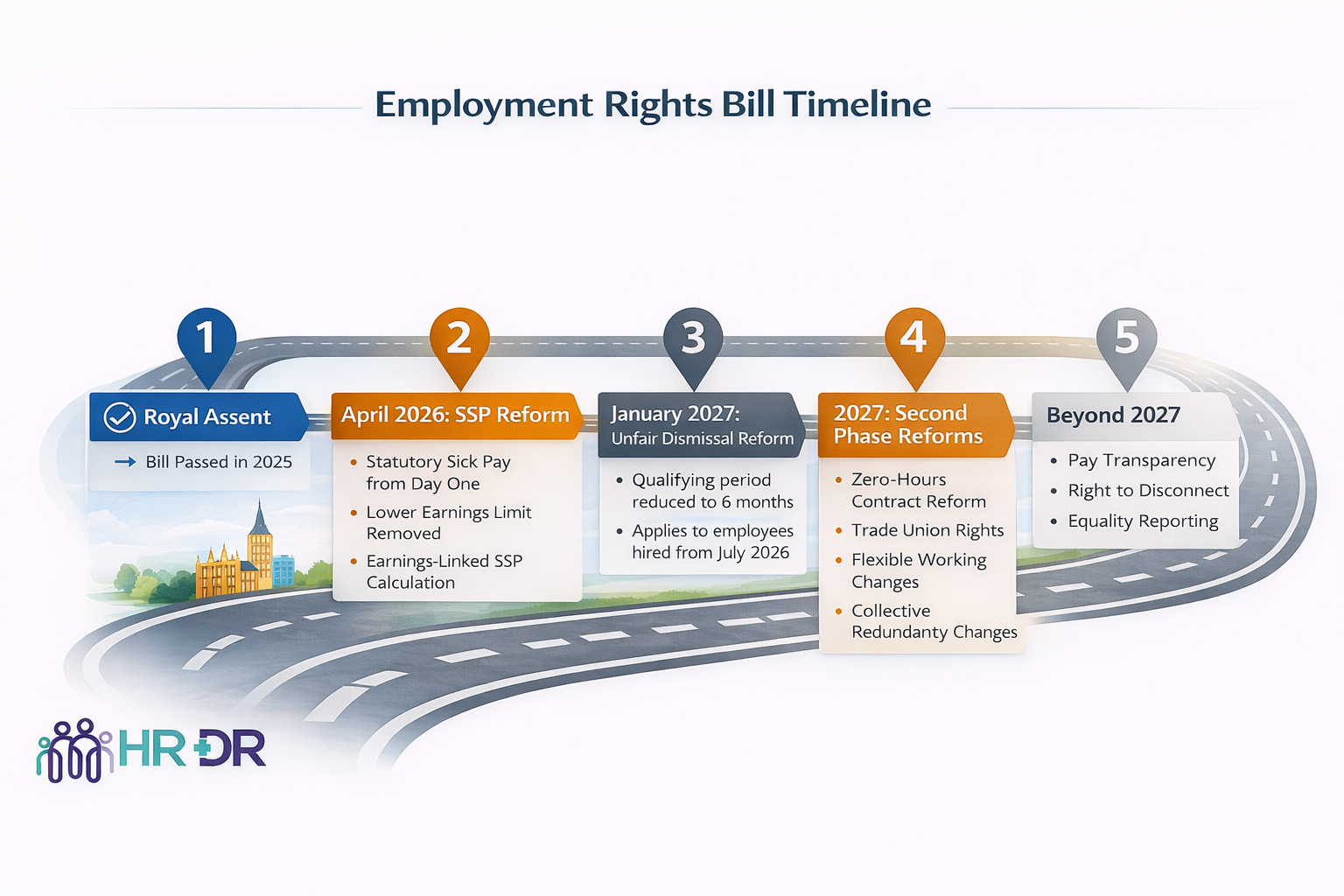
Employment Rights Bill Roadmap: When Will the Changes Come Into Force?
The question every employer is asking is a simple one: when does this affect my business? The answer is more complicated than a single date, because different provisions of the Act are being brought into force at different times. Here is the clearest roadmap available as of March 2026.
Royal Assent: Completed (2025)
The Bill passed through both Houses of Parliament and received Royal Assent in 2025. At this point, it became law in name, but no practical employment law changes were triggered. Think of this as the starting gun; it confirmed the direction of travel and gave employers a definitive signal that change was coming.
April 2026: First Wave
April 2026 is the first significant implementation milestone. The changes confirmed for this date are:
- Statutory Sick Pay reforms: SSP payable from day one of sickness absence; lower earnings limit removed; new earnings-linked calculation applies (see SSP section below)
Other provisions previously associated with April 2026, including changes to unfair dismissal qualifying periods, have since been moved to later commencement dates. Employers should not treat April 2026 as a general employment law reset date.
January 2027: Unfair Dismissal Qualifying Period
Key Change
The unfair dismissal qualifying period reduces from two years to six months for dismissals from 1 January 2027. Any employee hired from July 2026 onwards whose employment reaches six months will have the right to bring an unfair dismissal claim. The two-year qualifying period is not simply retained, it is replaced entirely by a six-month threshold (unless regulations change).
2026/2027: Second Phase
The second wave of implementation is expected to cover:
- Zero-hours contract reforms: workers gain the right to a guaranteed-hours contract where a regular pattern exists (expected 2027, subject to consultation and commencement)
- Strengthened trade union access rights: enhanced rights to access workplaces, recruit members, and organise
- Flexible working: further strengthening of employer obligations when considering requests
- Changes to collective redundancy consultation thresholds
Beyond 2027: Longer-Tail Provisions
Some provisions will take longer to fully implement, including measures around pay transparency, equality reporting, and the right to disconnect. These are less immediately pressing for most SMEs but should be on your radar for longer-term HR planning.
The Honest Warning
The roadmap sounds orderly. In practice, secondary legislation can be delayed, implementation dates can shift, and detail within each phase can change during consultation. The safest approach is to treat the April 2026 SSP changes as locked in, plan now for January 2027, and keep a close eye on updates to the remaining phases as they are confirmed.
Employment Rights from Day One: What Changes?
In the UK, employees for many years have the right to claim automatic unfair dismissal from day one, where the dismissal directly relates to automatic unfair reasons such as whistleblowing, health and safety concerns, and certain union activities.
This is the part of the Employment Rights Act 2025 that will have the biggest practical impact on how SMEs hire, manage, and exit people. The shift to employment rights from day one is moving to a 6-month qualifying period for dismissals from 1 January 2027.
Unfair Dismissal: What It Really Means
Under current law, employees need two years of continuous service before they can bring an unfair dismissal claim. This qualifying period has been a cornerstone of employer flexibility for decades. It has allowed businesses to take a chance on candidates, try things out, and part ways quickly if the relationship was not working, without the overhead of a full process or the risk of a tribunal claim.
From 1 January 2027, that changes. The two-year qualifying period is reduced to six months. Any employee whose employment began on or after July 2026 will acquire the right to bring an unfair dismissal claim once they have six months of service. The legal test was whether there was a fair reason, whether a fair procedure was followed, which applies from the six-month mark.
Let that land for a moment. Someone hired only six months ago has the same fundamental right not to be unfairly dismissed as someone who has worked for you for fifteen years. This is not day one unfair dismissal protection, but six months arrives faster than most employers expect, and the implications for early-stage exits are significant.
Many smaller businesses have relied on the two-year qualifying period as a buffer, a window in which they could make quick decisions about new hires without the burden of a formal HR process. That buffer effectively disappears for anyone hired from July 2026 onwards.
Probation: Best Practice, Not a Statutory Framework
The draft regulations have discussed a lighter-touch dismissal procedure during a defined probationary period. As of March 2026, a statutory probation framework has not been confirmed for April 2026, and the period of any such framework remains subject to final commencement provisions.
The practical approach for employers is to treat probation as robust contractual best practice rather than wait for a statutory framework to define it. Your employment contracts should include a clearly defined probation period, with written expectations, documented review points, and a fair process if concerns arise. This positions you well regardless of how the final regulations land.
The key point is this: with unfair dismissal rights applying from six months, the probation period your contract sets must be designed to give you time to identify and address issues, and document that process, before that threshold is reached.
Zero-Hours Contract Reforms
Zero-hours contracts have been a flashpoint in the workers' rights debate for years. The Employment Rights Act 2025 does not ban them, but it substantially changes the rules around when and how they can be used.
The centrepiece of the reform is the right to a guaranteed-hours contract. Where a worker on a zero-hours arrangement has worked a regular and consistent pattern of hours over a defined reference period, their employer will be required to offer a contract that reflects that pattern. This reform is expected to come into force in 2027, subject to consultation and commencement orders. The reference period is expected to be twelve weeks, though this is being confirmed through secondary legislation.
This matters enormously for hospitality, retail, social care, and other sectors that have relied heavily on zero-hours contracts for workforce flexibility. If someone on your zero-hours roster has effectively been working the same shifts week after week, you will need to offer a contract that reflects that reality.
What this does not mean is that zero-hours contracts become illegal for genuinely variable work. If your business has truly unpredictable demand, events, seasonal work, emergency cover, and workers are called in on an irregular basis, zero-hours arrangements can still be appropriate. The reform targets the misuse of zero-hours contracts for what is effectively regular employment, not their legitimate use for genuinely flexible staffing.
Flexible Working Changes
The right to request flexible working has applied from day one since April 2024. Further strengthening of employer obligations is expected under the Employment Rights Act 2025, with detailed provisions scheduled for 2027.
Employers can still refuse a request on prescribed business grounds, such as the burden of additional costs or detrimental impact on performance. But the trajectory of reform is clear: refusals must be properly reasoned, explained in writing, and demonstrate genuine consideration of whether the request could work. Response timescales are being tightened.
For SMEs, this means flexible working requests can no longer be batted away with a formulaic response. Each request needs a thoughtful, documented answer, which in turn requires line managers who understand the process and take it seriously.
Statutory Sick Pay: Changes from April 2026
Of all the changes in the Employment Rights Act 2025, the SSP reforms are perhaps the most financially underestimated, particularly for businesses with large numbers of part-time or lower-paid staff.
Currently, SSP does not kick in until the fourth day of absence. The first three days are waiting days during which employers pay nothing, unless their contract is more generous. From 6 April 2026, the waiting period is removed entirely, SSP is payable from day one of sickness.
The second reform compounds this: the lower earnings limit for SSP eligibility is also removed, meaning lower-paid workers who previously did not qualify will now be entitled to sick pay for the first time.
SSP Calculation Change
The method for calculating SSP is also changing. Rather than a flat weekly rate, the new approach introduces an earnings-linked calculation, expected to be 80% of average weekly earnings or the flat-rate SSP figure, whichever is lower. For cost modelling purposes, this means your actual SSP liability will vary by employee rather than being a fixed weekly number. Build this into your financial planning now.
Across a full year and a workforce of any size, this adds up. Every short-term absence, a 24-hour illness, or a one-day absence now attracts an SSP payment. For businesses in hospitality, retail, cleaning, and care sectors characterised by high numbers of part-time, minimum-wage workers, this is a material cost increase that needs to be built into financial planning now, not absorbed as a surprise in April.
How Will the Employment Rights Bill Affect SMEs?
Large businesses have HR departments, legal teams, and compliance officers whose job is to absorb exactly this kind of legislative change. They can audit their workforce, rewrite contracts, train managers, and build new processes; all before the first commencement date. Most SMEs cannot do any of that without external support. And the Employment Rights Act 2025 is not going to be kind to businesses that are unprepared.
Every New Hire Carries More Risk
Before July 2026, taking a chance on a hire carried manageable risk. From July 2026, anyone you recruit will acquire unfair dismissal rights after six months, which means your hiring decisions, onboarding, and probation management all matter significantly more than they did before.
Your Contracts and Policies Are Probably Outdated
Most SME employment contracts were written years ago and rolled forward with minimal updates. They almost certainly do not reflect updated SSP entitlements, the new SSP calculation approach, or the strengthened flexible working provisions. An outdated contract is not just an administrative problem; in a tribunal dispute, it is often the first document examined.
Managers Are Your Biggest Legal Risk
In employment law, the actions of a line manager are the actions of the business. If your manager handles a probation review badly, skips documentation, or fails to give an employee a chance to respond, the business carries the liability. Most SME managers are not HR professionals. Manager training is no longer optional.
Tribunal Risk Is Rising: and Will Rise Further
Employment tribunal claim volumes have been increasing since the abolition of tribunal fees in 2017. Reducing the unfair dismissal qualifying period from two years to six months will bring significantly more early-stage exits within scope for tribunal challenge, and is widely expected to increase the volume of claims. Every early-stage exit will need to be legally defensible. Without proper processes, documentation, and HR support, SMEs are significantly exposed.
What Employers Should Be Doing Right Now
The instinct of many business owners when faced with a major piece of legislation is to park it until it becomes immediately relevant. That instinct will be costly here. April 2026 is close, January 2027 is not far behind it, and the businesses that will be best placed are those that start now.
- Conduct a contracts and policies review. Pull your standard employment contract and key HR policies: disciplinary, sickness absence, and flexible working, and read them critically. Do they reflect updated SSP rules? Do they include a clearly written probation process? If they have not been reviewed in the last twelve months, they almost certainly need updating.
- Build a proper probation process. You need a written probation policy that sets out how probation works, what the review points are, what the procedure is when performance or conduct is a concern, and how the period ends. This process needs to be embedded in practice; not just filed away as a document nobody reads. With unfair dismissal rights arriving at six months, the quality of your probation process matters from day one of every new hire.
- Brief and train your line managers. Every manager who supervises people needs to understand what the six-month unfair dismissal threshold means in practice, what a fair probation process looks like, and what to do, and what not do, when a new hire is not working out.
- Review your zero-hours workforce. Map who is on zero-hour contracts and what their actual working patterns look like. Identify anyone working regular patterns that would trigger guaranteed-hours obligations when those rules arrive in 2027. Getting ahead of the conversation is far less disruptive than waiting to be forced into it.
- Model the financial impact of SSP reform. Look at your absence data for the past year. Estimate the cost impact of SSP applying from day one, applying to all eligible staff, and calculated on an earnings-linked basis. Build that figure into your budget planning now so it does not come as a surprise in April.
- Get external HR support if you do not have it in-house. If your business has no dedicated HR capability, the cost of putting that in place, whether through a retained HR consultancy or a managed HR service, will be significantly less than the cost of a single poorly managed tribunal claim.
Frequently Asked Questions
When will the Employment Rights Bill come into force?
The Employment Rights Act 2025 is being implemented in phases. The first confirmed change, SSP from day one and removal of the lower earnings limit, takes effect on 6 April 2026. The reduction of the unfair dismissal qualifying period from two years to six months applies to dismissals from 1 January 2027. Zero-hours contract reforms and other provisions are expected to follow in 2027, subject to consultation and commencement orders.
What are employment rights from day one?
The phrase 'employment rights from day one' refers broadly to rights that apply without a qualifying period of service. Some rights, such as the right to request flexible working and the right to written terms of employment, already apply from day one. The Employment Rights Act 2025 extends this principle further, including removing the lower earnings limit for SSP from April 2026.
The right to claim unfair dismissal is not a day-one right under the Act. The qualifying period reduces from two years to six months for dismissals from 1 January 2027, meaning unfair dismissal protection arrives at six months of service, not on the first day.
How does the Employment Rights Bill affect probation periods?
The Act does not introduce a confirmed statutory probation framework as of March 2026. The practical implication for employers is that probation periods should be treated as a robust contractual process, with written expectations, documented review meetings, a genuine opportunity for employees to respond to concerns, and a clear written outcome.
With unfair dismissal rights applying from six months from January 2027, the purpose of a probation period is to give employers time to identify, raise, and address performance or conduct issues before that threshold is reached. A probation period that is poorly documented or informally managed will not provide adequate protection in a tribunal setting.
Will the Employment Rights Bill apply in Scotland?
Yes. The Employment Rights Act 2025 applies across England, Scotland, and Wales. Employment law is a reserved matter, legislated at Westminster and applied uniformly throughout Great Britain. Northern Ireland operates under separate employment legislation and is not automatically covered by this Act, though Northern Ireland has historically mirrored GB employment law changes over time, often with some delay.
What is the Employment Rights Bill, and why does it matter for SMEs?
The Employment Rights Bill is the Labour government's landmark reform of UK employment law, introduced in October 2024 and now law as the Employment Rights Act 2025. For SMEs it matters because it removes the lower earnings limit for statutory sick pay from April 2026, reduces the unfair dismissal qualifying period from two years to six months from January 2027, introduces guaranteed-hours rights for zero-hours workers (expected 2027), and strengthens flexible working obligations, all of which increase employment costs, administrative burden, and tribunal risk for smaller businesses without dedicated HR support.
This article is intended as general guidance only and does not constitute legal advice. Employment law is complex and fact-specific. Always seek professional advice for your particular circumstances.
Planning ahead for the Employment Rights Act 2025? We work with businesses across the UK to review contracts, build compliant probation processes, train managers, and reduce tribunal exposure. Get in touch to find out how we can help.